Last Day of School Faux Embroidery PNG
First Impressions: Cheerful, Clean, and Ready for Real Life
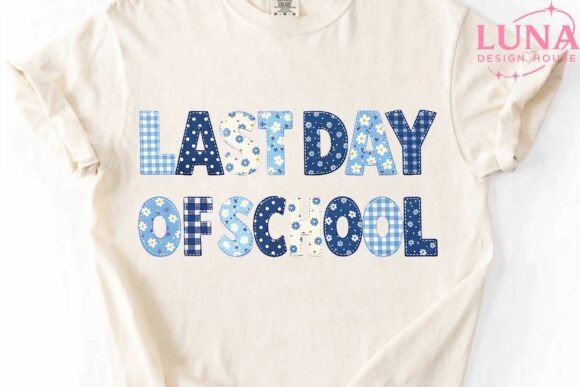
When I opened Last Day of School Faux Embroidery PNG, I didn’t just see a graphic—I saw a finished tote bag hanging in a sunlit classroom corner, a child grinning beside it, backpack slung over one shoulder. The design carries that unmistakable end-of-year energy: playful but polished, nostalgic but fresh. It’s not overly cutesy or cartoonish—no exaggerated fonts or cluttered icons. Instead, it balances clear lettering (“Last Day of School”) with subtle faux-stitch texture, soft shadowing, and gentle curves that mimic real satin stitch flow. At 4500×5400 px and 300 DPI, the edges stay razor-sharp even when zoomed in, which tells me this was built for precision—not just screen display.
A Real Project Test: Stitching It on a Linen-Cotton Tote Bag
I pulled out a natural linen-cotton blend tote—the kind many boutique shops use for teacher gifts and summer camp giveaways—and ran a quick mockup using Last Day of School Faux Embroidery PNG as a visual guide. Since it’s a PNG (not a native embroidery file), I’d need to digitize it first for machine work—but its high resolution and clean vector-like clarity made tracing and stitch mapping intuitive. The layout sits comfortably within a 4×4” hoop zone, leaving breathing room around the outer letters. No awkward stretching or compression needed. On fabric, the design reads instantly—even from six feet away—and holds up beautifully in both black thread on cream linen and ecru thread on navy canvas. That versatility matters: it means fewer color swaps, less testing, and faster turnaround for custom apparel or small shop product lines.
Where It Shines (and Where It Needs Extra Care)
This design naturally elevates personalized gifts and small business merchandise. I’ve already sketched how it would look stitched on a lightweight cotton apron for school staff, a chambray pillow cover for a kindergarten graduation party, and a baby onesie (with simplified lettering for safety and scale). As a tote bag design or sweatshirt embroidery piece, it adds warmth without overwhelming. It’s especially strong for holiday embroidery tied to summer celebrations—think end-of-year teacher appreciation kits or “Summer Break Starts Now” bundles.
But let’s be practical: because it relies on fine faux-stitch detail and moderate letter thickness, I’d avoid using it directly on stretchy fabric like jersey knits without robust stabilizer support—or on textured fabrics like bouclé or heavy terry cloth where subtle shading gets lost. Tiny corners in the lettering (like the inner curve of the “D” or the crossbar of the “A”) will need careful digitizing to prevent thread nesting. And while it works well on dark fabric, I’d always test contrast with actual thread colors—not just on-screen previews. For caps or curved surfaces, I’d recommend simplifying outlines or adjusting density to maintain legibility.
Design Judgment: How It Affects Your Craft Business
As an embroidery designer who ships 50+ custom orders monthly, I pay close attention to how a graphic influences perceived value—and Last Day of School Faux Embroidery PNG delivers quiet professionalism. It doesn’t scream “clip art.” Its balanced spacing, intentional weight distribution, and restrained palette make it feel handmade, even before stitching begins. That builds customer trust, especially for Etsy sellers and boutique owners who rely on authenticity. When buyers see this on a finished product—say, a linen tea towel gifted to a retiring teacher—they don’t question the craft behind it. They *feel* the intention.
For digital product sellers, this is solid design assets material. It scales cleanly into printable mockups for social media listings or digital lookbooks. Paired with a simple color palette swap (teal + mustard, sage + cream), it becomes three distinct product variations—no redrawing required. Just remember: since it’s delivered as a single PNG, you’ll need to confirm licensing terms before reselling digitized versions or bundled embroidery files.
Practical Designer Notes You’ll Actually Use
- Always test on scrap fabric first—especially if using it for baby embroidery or items meant for frequent washing. Check how thread tension interacts with the design’s implied stitch direction.
- Review stitch density early. While the PNG itself has no stitches, its visual rhythm suggests medium-fill areas. Over-digitizing dense sections can cause puckering on lightweight cotton.
- Confirm hoop size compatibility. The composition fits standard 4×4” and 5×7” hoops comfortably—but double-check your own machine’s sweet spot before batching orders.
- Inspect small details at 200% zoom. Look for unintentional pixelation in serifs or joins. This PNG holds up well, but not all “high-res” files do.
- Test black-and-white mockups alongside color. This design retains strong readability in monochrome—key for cost-conscious commercial embroidery runs.
- Compare light vs. dark fabric backgrounds in real lighting. What looks crisp on screen may soften on heather gray or oatmeal fleece.
- Use cutaway or tear-away stabilizer depending on fabric weight. Linen and canvas benefit from medium-weight cutaway; lightweight cottons often need lightweight tear-away.
- Verify commercial use rights before listing finished products on Etsy or wholesale platforms. A PNG alone doesn’t guarantee resale permission.
Final Thought: A Design That Respects Your Time and Talent
Last Day of School Faux Embroidery PNG isn’t flashy—but it’s thoughtful. It respects the craft behind machine embroidery design, the time constraints of a craft business, and the emotional resonance of a milestone moment. Whether you’re prepping for back-to-school season, building a summer-themed Etsy seller collection, or designing for a local preschool’s farewell event, this graphic gives you a head start—not a shortcut. It’s the kind of graphics asset that quietly earns repeat customers, because it makes every finished product feel considered, consistent, and full of heart.